
You Don't Win by Watching the Scoreboard
 Josh Hartsell 5 min read

I have to tell you something a little embarrassing.
I once broke a ping pong paddle in half…and not by accident. I was losing a game and I got frustrated and I smacked the table hard enough to splinter the paddle into several pieces.
It was many years before I'd let myself play again because I apparently get a little too invested when there's a score involved. I dislike losing (:
Not all of us are competitive. But most humans are driven to succeed. We crave being part of a team that's winning. And it turns out that instinct — the one that ruined ping pong for me — is one of the most useful things a leader can put to work… if you point it at the right number.
Let me explain what I mean.
Most of us are watching the wrong number.
I was sitting with a relatively new leader a few weeks ago. She is sharp and disciplined. She already had the habit we talk about all the time – setting aside time at the start of your day to pick the most important things to focus on before your day picks them for you.
Now that the habit was in place, we were talking about the next challenge. How do you know you're picking the right ones? How do you know your energy is landing where it'll actually move what matters?
So I backed up and asked her the company-wide question. “Where are you all headed, and how do you know if you are winning?”
She didn't hesitate. There was a specific number the whole building was chasing, and she knew it instinctively.
“Okay, great. Now think about your team. Of everything you could do, what would have the biggest outsized impact on hitting that number?”
Again, no hesitation. "I need to get my people cross-trained. Right now if one person is out, a machine sits."
Great answer.
Then the question that really unlocks a team's effectiveness. "What are you tracking to make sure that's actually happening?"
She paused. And I could tell the question didn't quite land, so I tried it a different way.
"If cross-training is the most important thing your team can do right now — are you tracking how many minutes a day, or a week, you're actually spending doing it?"
"No. Some weeks it's probably zero."
That was the most useful thing she said all morning. Because in that moment she realized she had a scoreboard she was watching to see if they were winning: the company-wide goal.
But you don't win by watching a scoreboard. You win by putting points on it. And points come from a specific, repeatable activity you can do today.
A business owner recently explained it like this. In football, the goal is a touchdown. But nobody on the field is thinking about the touchdown. You get four tries to move the ball ten yards. That's it. String enough of those together and the touchdown takes care of itself.
The people who wrote The 4 Disciplines of Execution have names for this. The scoreboard number — parts out the door, revenue, turnover — is a lag measure. It tracks the result. By the time you can read it, it's already happened, and there's nothing you can do about that number anymore.
The lead measure tracks the activity. The thing that produces the result, that you control, and that you can do more of tomorrow.
So the question becomes: what activity are you tracking that guarantees the results you want?
Here are a few more examples:
If you are in sales, your monthly numbers are the big scoreboard. But the lead activities that get you there might be the number of outbound calls a day or proposals sent a week.
If you're on the shop floor, the lag measure could be scrap rate, or parts out the door. The lead measure might be first-piece inspections done before a run starts, or setups verified by a second set of eyes.
If turnover is the number keeping you up at night, the lead measure might be one-on-ones that actually happened this week, or minutes spent with a new hire in their first thirty days.
Same idea every time. The lag measure tells you whether you won. The lead measure is how you play day-to-day.
Why goals stall out.
This is where I think most of us get tripped up, and it isn't a goal problem. Most of us set goals. The trouble is that a goal is a destination, and a destination doesn't tell you what to do Monday morning.
Turning the destination into something you can do tomorrow…that's the work.
It's smaller and less glamorous than a goal-setting session: name the activity, make it a number, put it where the team can see it, check it every week. It's one of the operating habits we keep finding underneath leaders who consistently get the most out of their people. It's not flashy, but it works.
Here's how to actually find your lead measure.
- Write the result at the top, then list the levers. The result is the one number the building is chasing. Under it, list everything your team could do that might move it. Don't filter yet. Get eight or ten down. For our new leader that list had cross-training on it, but also faster changeovers, a second-shift lead, getting engineering to respond quicker.
- Pick the one with the most leverage, then run two tests. If we did more of this, would the result move? And can my team do more of it this week without waiting on anyone else? Cross-training passes both tests. "Get engineering to respond quicker" fails the second one because that's somebody else's team.
- Define it in three parts: what, who, how often. Thirty minutes of cross-training. One operator on one machine. Every day. Now it isn't an intention. It's a box you can check. That's the test of whether you've got it small enough: at the end of the day, can you say "yes, we did it" or "no, we didn't" in one word? If the honest answer is "sort of," keep breaking it down.
- Post it, and check it once a week. Keep it simple. Even tally marks on a whiteboard are plenty. Then five minutes, same time every week: did we do it, what got in the way, what's each of us doing next week. It's the smallest meeting you'll run and the one that does the most.
- Ask the question again. Lead measures have a shelf life. Once everyone's cross-trained, that number stops moving anything. So you go back to the top of the notepad and find the next ten yards.
Here's what becomes possible.
A few weeks from now, nobody on your team is asking what to work on. They know their number, and they own it. At the end of the day the question isn't "did we hit the big goal" — that was never going to get answered on a Tuesday. It's "did we get our ten yards?" And the big number, the one you couldn't move by staring at it, starts moving anyway. Because the thing that produces it got done today.
That's a team that knows it's winning. And a team that knows it's winning plays differently.
Do all the right things to precision and the score will take care of itself.
p.s. What, who, how often. If your number doesn't have all three, it's still a wish.
Helpful resources.
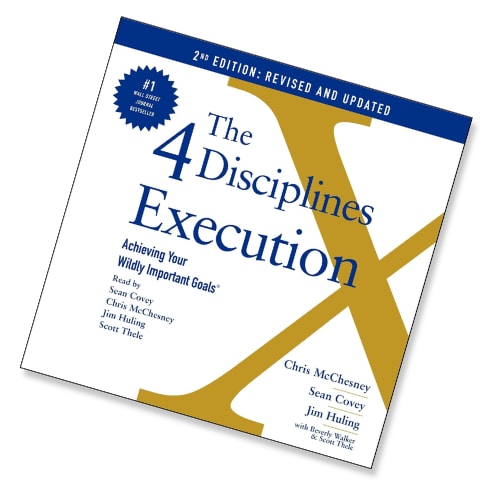
The 4 Disciplines of Execution (4DX)
Need help turning big goals into actual results? This book is a no-fluff, step-by-step guide for taming the whirlwind and getting things done. A must-read if you’re chasing big goals.