
The Law of Process
 Josh Hartsell 5 min read

How vividly do you remember learning to ride a bike?
I can remember the street my dad taught me on, and I vaguely remember a few attempts with him running along behind me before he let go and I realized I was on my own. Beyond that, the memories of that day are pretty minimal.
Barring a major crash or a real struggle to learn, I’m guessing most people’s stories are similar, because once you learn to ride a bike, you sort of always know how. It’s why the phrase exists. I haven’t been on a bike in probably ten years, and I’d hop on one right now without a second thought.
Learning to lift weights was quite the opposite experience for me. I’ve mentioned here before that I didn’t play sports beyond fifth grade, so the gym always intimidated me! But by the time I was 26 and still a lanky 120 pounds, I decided I wanted to be brave and see if I could build muscle.
True story:
I was so insecure about being seen by anyone I knew while learning to lift that instead of walking 30 seconds to the gym on the campus (…where I lived… and could work out for free), I convinced my friend to drive across town with me to a hole-in-the-wall gym. It’s embarrassing to admit now, but I reallllllly didn’t want to be seen (or judged) by any of my students.
We didn’t last 10 minutes across town, because it turns out learning to bench press around strangers in a sketchy, run-down gym is worse than risking judgment from people you know. So, back to campus it was.
Eventually I got past the fear and the insecurity. And after many weeks, a lot of sore muscles, lessons about form, videos of different lifts, reading up on supplements and recovery, and learning to swallow my pride and ask for a spotter when I needed one, I built the know-how and put on 20 pounds of muscle, enough that people noticed.
A few years later, I left my job at the college, and my new schedule made it tough to get to the gym consistently. Within a few months I’d lost about 10 of those 20 pounds. I still remembered how to lift. The muscle, on the other hand, forgot to stay with me. The knowing works like the bike. The results required that I keep showing up.
I’ve been thinking about that difference because of the third of John Maxwell’s 21 Irrefutable Laws of Leadership. His summary of it is simple:
The Law of Process: Leadership develops daily, not in a day.
Maxwell says that development happens in five phases:
Phase 1: I don’t know what I don’t know. At this stage, most people don’t yet see leadership as its own set of skills. They think of it as a title, or a personality, or something a few people are simply born with. If you’ve been successful at your job, it’s easy to assume you’ll be good at leading others who do that job.
Phase 2: I know that I need to know. This one usually shows up right after the promotion. You’re handed a team, you look around, and you realize people aren’t following quite the way you expected. A conversation goes sideways, or you notice one you’ve been avoiding for weeks. It’s uncomfortable, and it’s good news, because this is where growth actually starts.
Phase 3: I know what I don’t know. Now you can name the gaps — managing your time, giving honest feedback, having the hard conversation before it becomes a crisis. Maxwell’s point is that this is when you start growing on purpose, a little every day. It’s also the hardest phase to sit in, because you can finally see the whole thing and you can’t do most of it yet. It’s the pain without the gain (yet).
Phase 4: I know and grow, and it starts to show. The daily work begins paying off. Your 1:1s stop feeling like a performance, and your team brings you problems earlier. Other people usually notice you’ve grown before you do. There’s no getting around the reality, though: it takes time and commitment to get here.
Phase 5: I simply go because of what I know. Leading becomes close to instinct. You read the room, make the call, and have the conversation without having to think through every step first.
Maxwell stops at five phases, but Matt and I think that misses something. Phase 5 reads like arrival — like at some point leadership just runs on its own. Which sounds an awful lot like riding a bike.
And it can be easy for us to treat leadership that way. We read the book, sit through the workshop, get the promotion, and assume we’ve picked it up for good. But leadership is a lot more like the gym. You can know exactly what good leadership looks like and still lose your effectiveness.
Anyone who has gotten healthier, whether it was with a barbell, a daily walk, or losing weight, will tell you the results are real, but if you stop the process you drift back toward where you started. Even Ozempic only works as long as you keep taking it.
Highly effective leaders know they’re not done at Phase 5. They keep doing the Phase 3 things long after they’ve gotten good at them. And in fairness to Maxwell, he summed up his own law as “daily, not in a day,” so I suspect he’d agree.
If you’re newer to leading, that’s actually good news. Because it’s a process, you aren’t supposed to be good at it yet. Like the gym, you’ll do it imperfectly and in front of people, you’ll have good days and bad ones, and you won’t see much change from one day to the next. It happens anyway, over months, for the people who keep showing up.
A few things to try this week.
- Name your phase. Pick the one leadership challenge that’s hardest right now and ask which of Maxwell’s five phases you’re in. “I don’t know what I don’t know” is an honest answer, and it’s where everybody starts.
- Pick a process, not a result. “Be a better communicator” is a result. “Hold my 1:1s every week and don’t cancel them” is a process. Nobody gets healthy in one go; they take a walk, and then they take another one. Pick your walk.
- Ask someone further along. Find a leader you admire and ask what they do every week on purpose. The answer will probably be boring, which is usually how you know it’s the right one.
The great thing about this law...It doesn’t ask for talent — it certainly didn’t ask me to be an athlete. It asks for today, and then it asks for tomorrow. And every time you show up, you get a little stronger.
Leadership and learning are indispensable to each other.
p.s. Talent decides where you start. Consistency decides where you end up.
Helpful resources.
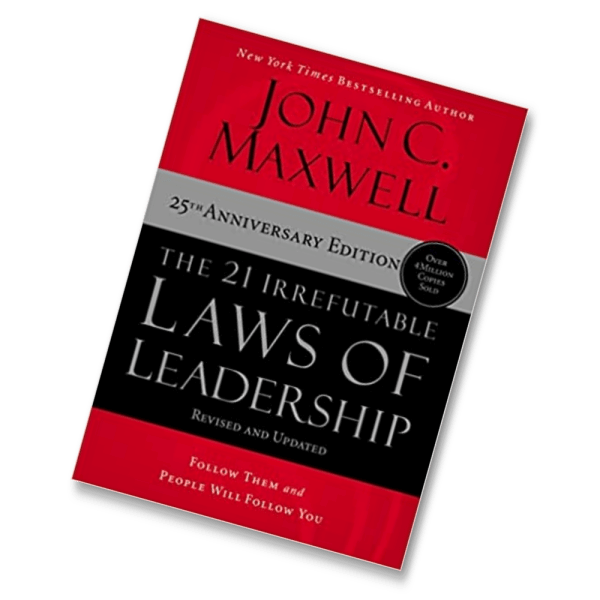
21 Irrefutable Laws of Leadership
Maxwell breaks leadership down into 21 laws that just make sense. It’s straightforward, packed with wisdom, and full of those 'Ah-ha!' moments. Perfect for anyone looking to level up how they lead and influence others.