
The Law of Influence
 Josh Hartsell 5 min read

An upset teacher once told me, to my face, "I can't wait until parent-teacher conferences so I can tell your parents how you act in my class."
I was a freshman in high school, and I don't remember the smart-alecky comment I'd made to push her to her limit. But unlike most students, who probably would have taken that as a sign they were on thin ice, I laughed and said, "They won't be coming. I told them they didn't need to."
Now, before you decide I was a complete monster of a student, let me back up and give you a little more context.
I was a nerd. I liked school. I was well liked by almost all of my teachers. Straight A's, eager learner, the kid who went above and beyond.
For reasons I'm still not sure of, this particular teacher never really cared for me and I was never able to win her over. We were never on truly bad terms. Nothing ever went further than being told to be quiet or getting a stern look. But there was clearly a miscalculation in the relationship somewhere. Probably on both sides.
Back to the standoff. My best guess is I was trying to be funny and instead I was obnoxious, and that day she decided to up the ante by invoking the threat of my parents. What she didn't know was that, because I'd never had issues in school and had good grades alongside glowing teacher reports, my parents had told me they'd happily go to conferences in high school if it was important to me. Otherwise, they trusted me and the report cards.
Armed with that knowledge, it brought 15-year-old me great pleasure to neutralize her threat.
My parents didn't go to conferences. And I never did learn how to win her over.
But I think about that moment a lot when I think about John Maxwell's Second Law of Leadership, the Law of Influence.
Maxwell puts it about as plainly as it can be put: "The true measure of leadership is influence- nothing more, nothing less."
In that classroom, she had the title. She had the authority. She even had the grade book. What she didn't have was strong influence in my life. She was in charge, but she hadn't managed to actually lead me.
When I look back at every teacher I ever had real friction with, the funny part is that they were all math teachers. Seventh grade. Eighth grade. High school. And the one week of college math before I dropped the class.
Not surprisingly, I never got great at math.
That's just how influence works. We learn best from the people we've decided to follow.
Teaching, like every leadership role, can't get around the Law of Influence. Coaching, parenting, running a team, building a business- it all runs through it. The title gets you in the room. Influence is what makes people want to follow you once you're there.
None of us sets out to lead on title alone. But there are a few very believable ideas that make it easy to think we're leading when we're mostly just in charge.
Maxwell calls them the five myths of leadership.
Myth #1: The Position Myth. Assuming the title does the work. My math teacher's version was, essentially, "I'm the teacher, so you'll listen."
Myth #2: The Management Myth. Treating managing and leading as the same thing. Management keeps things running; leadership moves people. You can run a perfectly organized office or shop and never learn how to develop influence with others.
Myth #3: The Knowledge Myth. Assuming whoever knows the most should lead. It's why we promote the best technician, the best salesperson, the best engineer. Knowing the work and moving people are two different skills. (My math teacher, for the record, absolutely knew math.)
Myth #4: The Entrepreneur Myth. Thinking that if you can sell, you can lead. Getting someone to say yes once is a transaction. Influence involves a longer term relationship and sacrifice.
Myth #5: The Pioneer Myth. Assuming whoever's out in front is the leader...the founder, the first one in, the one with the big vision. As Maxwell likes to say, if you think you're leading and no one is following, you're only taking a walk.
Every one of those myths is a shortcut. A quiet hope that something other than influence will do influence's job.
The great news, as we've talked about before, is that you don't need the shortcut. Influence can be built intentionally. It isn't rocket science. It's a handful of ordinary behaviors, repeated consistently over time.
The leaders we've watched build real influence didn't stumble into it. They worked it into their rhythm. It’s in the one-on-one they don't cancel, the follow-up they actually send, the "help me understand" before the correction. Small deposits of trust, made on purpose, week after week.
A few things to try this week
Check your shortcuts. Read back through the five myths and ask honestly: which one do I lean on when I'm tired or rushed? Most of us have a favorite. Name yours. Just naming it changes how you show up.
Run a quick influence audit. Look at last week's calendar. How much time went to things that build trust with your people- listening, developing, following through- versus directing traffic? No judgment. Just get an honest read.
Practice one trust habit on purpose. Pick one and practice it this week. Maybe it's keeping a small commitment you'd normally let slide. Maybe it's listening first in your next one-on-one before you offer your take. One habit, done consistently, beats a whole list you admire.
I don't think my high school math teacher had any ill intentions, and I don't condone how I acted.
But, I like to think there's a version of my freshman year where that teacher caught me after the bell and genuinely asked, "Hey, what's going on with you?"
I'd like to think it would have changed things. For her and me- and maybe even for me and math.
Become the kind of leader that people would follow voluntarily, even if you had no title or position.
p.s. The title gets you in the room. Influence is what makes people want to follow you once you're there.
Helpful resources.
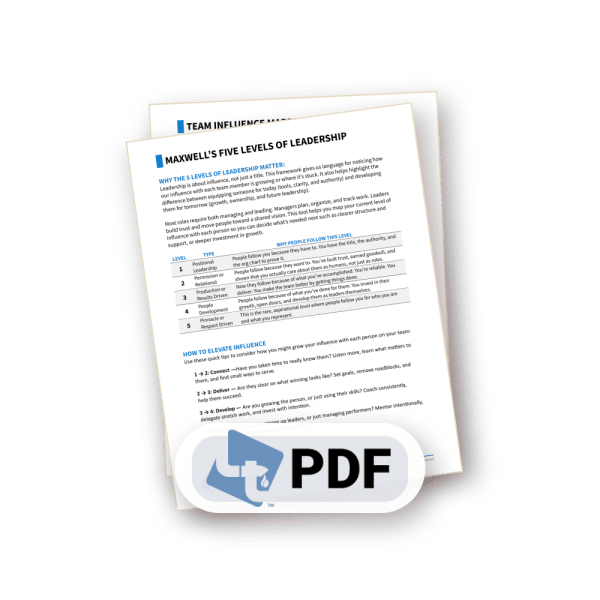
5 Levels of Leadership: Team Influence Mapping Worksheet
Map where your influence stands with each person on your team, against Maxwell's five levels.