
Tension Is a Stretch, Not a Snap
 Matt Metzger 5 min read

Recently I got to go on a legacy trip.
Think family vacation, but not the whole family, and intentionally multigenerational. My parents, both in their mid-seventies. My teenage son. And me.
Mom had the dream. This was a place she'd wanted to see her whole life.
I had the planning.
My son had the muscle, and hopefully some memories with his grandparents that will outlast all of us.
Quick sidenote before we go any further: no matter what I say below, if you ever get the chance to take a multigenerational trip, make it happen. The memories were remarkable. We're closer because of it.
I’d been planning this trip for months. Doing my research. Dialing in exactly what I thought Mom would love. Looking at pictures. My parents spent an embarrassing amount of time on YouTube collecting every tip and trick the internet had to offer. They loved every minute.
Travel day launched us on pure energy and adrenaline. Logistics were smooth. All the little steps were falling into place.
Then we settled in and the adrenaline wore off...
And tension showed up.
Now, I'm trying to be impeccable with my words here. I did not say conflict. Not aggression. Not argument.
Tension.
Tension is stretching. It's what happens when you put a material under pressure. Your muscles go under tension when you work out. Your mind goes under tension when you're learning something new. And your closest relationships go under tension when you drop them into new places, new experiences, and new expectations.
Tension isn't a sign that something's broken. More often, it's a sign that something's being pushed to places it’s never been.
So there we were. Thousands of miles from home. Four people who love each other dearly, each responding to the same new world in completely different ways.
Mom and Dad got tired. My son does not get tired.
Mom and Dad wanted to read every sign in every museum. My son wanted to see everything except museums and never stand still.
Mom and Dad wanted to chat with strangers in a language none of us spoke. My son wanted to pretend he didn’t know us when they did that.
And there I was in the middle. Wanting everyone to enjoy the trip. Wanting everyone in harmony. Quietly working overtime to make sure nobody felt any tension at all.
Reflecting on all this just days after the fact, I’m now thinking of all of you.
That spot in the middle isn't so different from where you as managers and leaders live every day.
You've got a big mission. Work that has to get done to reach it. A group of people who, by and large, genuinely want good for each other. And a steady supply of new circumstances, challenges, and curveballs that stretch those good people in different directions.
And there you are in the middle, keeping things moving and holding everyone together.
Here's what years of sitting with leaders has shown us. The leaders whose teams get stronger under pressure usually aren't the ones who've found a way to avoid tension. They're the ones who've built a rhythm for working with it. It's one of those quiet, foundational habits, and like any habit, it's learnable.
If you're feeling some tension as the week kicks off, here are three experiments to try.
1. Slow down.
Tension around us creates tension inside us. Our brains are wired to read and mirror the emotions of the people near us. The same engine that powers empathy and compassion can also get us worked up when everyone else is worked up.
Around day two or three, my parents started slowing down. My son hadn't noticed yet. His frustration was coming, and I could see it. Then I felt my own rising, because I didn't want Mom and Dad to feel pushed around. I could have snapped; told my son to chill out. But instead, I took a breath. I slowed down. I remembered that my son was just doing what teenagers do, which is being ready to go. That pause turned what could have been a sharp moment into a really good conversation.
So breathe. Get some sun on your face if you can find it. Name the stress you're under, and then name where it's coming from.
2. Close the loop.
Once you know the source, have the conversation that needs having. Our brains hate open loops, and every task we leave undone quietly piles on more stress. When the open loop is tension on your team, that one is yours to close. Remember Josh's note on the Law of the Lid a few weeks back? Your team rises to the level of the leadership around it. Resolution, or at least real progress, usually starts with you being the first one to say the awkward part out loud.
3. Assume the best.
When you step into the tension, assume the other person doesn't want it either. Maybe they don't feel it. Maybe they don't know what to do about it. Maybe they don't realize they're part of it. (My son wasn't trying to run his grandparents ragged. He just hadn't noticed the pace yet.)
Stay curious. Ask for their perspective, then go two or three questions deeper. Only after seeking to understand can you paint a picture of the common ground you're both reaching for.
The trip was a wild success and a ton of fun. It was a delight to see my mother beaming and watch my son connect with his grandparents in new ways.
Every now and then, I had to remind my son about pace differences and kindly ask him to slow down for us. Every now and then, I had to ask my parents whether they wanted to spend hours in museums when they were teenagers. :)
And every single day, I had to remind myself that tension in any relationship is 100% natural. The stretch that comes from our differences is exactly what makes us stronger together.
Here's to finding the ways your team can be stronger together this week.
Daring leaders who live into their values are never silent about hard things.
P.S. The person on the other side of the tension probably doesn't want it either. Start there.
Helpful resources.
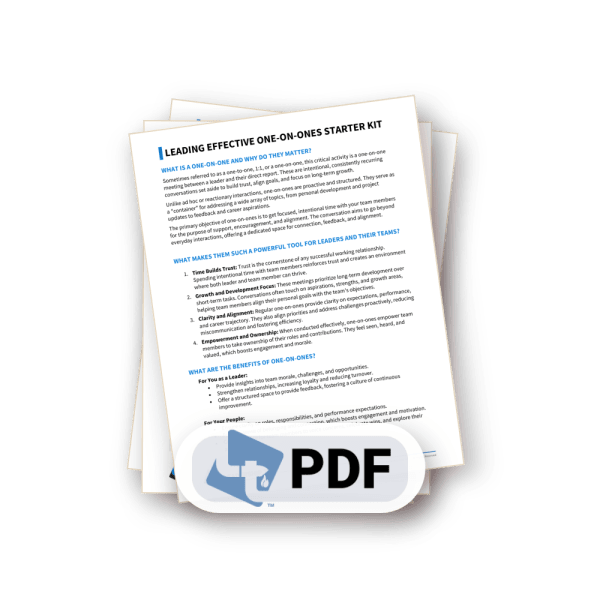
One-on-One Guide
One-on-one meetings are one of the most powerful tools for leadership effectiveness. This guide walks leaders through why these meetings matter and how to conduct them with purpose. It includes best practices, key discussion areas, a preparation worksheet, and sample questions to make every one-on-one meeting more productive. Whether you're starting fresh or refining your approach, this resource ensures that one-on-ones become a tool for growth and alignment.