Ask First, Talk Last
 Matt Metzger 4 min read
Raise your hand if you've ever read Robert's Rules of Order, the official guide to parliamentary procedure.
Anyone?
Bueller?
Alright, let me push up my nerd glasses for a second and confess that I genuinely enjoyed my training in meeting facilitation when I was 15 years old.
And yes, here I am talking about meetings again. But since you spend so many of your work hours in them, it only seems fair to spend a proportional share of Insiders on the topic.
This round: when do you get to talk if you're the one running (please read: facilitating) the meeting?
Not when should you talk. When are you allowed to. These are Robert's Rules, after all. Not Robert's Suggestions.
The day I lost points for having an opinion
Back in my FFA days, we competed in a chapter meeting contest. Picture a room full of high schoolers pretending to be adults, gavels and all, while judges lob curveballs to see whether you can keep a meeting on the rails. It was exactly as nerdy as it sounds. We loved it.
Our team put me in the chair. A motion hit the floor, debate was underway, and one of the officials turned to me and asked for my position.
So I gave it. Confidently. Thoroughly.
We got docked. Badly.
What my 15-year-old self didn't know yet: under Robert's Rules, the person presiding doesn't get to jump into the debate. If the chair wants to argue for or against a motion, they have to step down and hand the gavel to someone who hasn't taken a side. Only then can they take a seat and speak their mind.
I had the title of chairman. I didn't yet have the skill of one.
The gavel is heavy
Henry Martyn Robert, the Army officer who wrote the rules, wasn't being fussy. He understood something about gravity.
The person holding the gavel shapes the room just by sitting in that seat. When the facilitator weighs in, the conversation tilts. People on the other side of the argument get a little quieter. Some ideas never quite make it out loud.
Your weekly team meeting probably doesn't have a gavel. (If it does, count me curious. And please invite me.) But if the people around that table report to you, the gravity is there anyway.
Maybe you're thinking, "But Matt, we're a pretty flat team. We've got great relationships. They know they can push back."
I believe you. And I believe you really do want them to.
So let me say the awkward part out loud: humans don't naturally rise up against power. We look for safety. The rare person will challenge an assertive boss in the middle of a meeting, but most won't. Not because they're short on ideas — because the room has quietly signaled whose ideas count most.
The leaders who get the best thinking out of their people tend to build a simple rhythm into how they run conversations. They set the table, they draw everyone out, and they save their own opinion for the end. It's one of those small operating habits that, practiced week after week, reshapes what a team believes it's allowed to contribute.
What this looks like in practice:
Set the table, then step back. Speaking first isn't the issue. Speaking your opinion first is. Open with the purpose of the conversation, the context, the constraints, and what a good outcome looks like. Cast the vision. Then hand over the floor.
Ask by name, not to the room. Remember CPR training? You never yell "Somebody call 911!" at a crowd, because everyone assumes somebody else will. You point: "You in the blue jacket; call 911." Meetings work the same way. "What does everybody think?" usually earns a lot of thoughtful silence.
Try instead: "Joe, what do you like most about this idea?" "Sally, where's the weak spot?" "Barry, if this doesn't work, what's the most likely reason?" Ask for strengths and weaknesses. Ask who'd champion it. Ask how long it would really take.
Talk last. On purpose. Once every voice is on the table, it's your turn. Highlight the points you agree with. Gently nudge the ones you don't. Respectfully poke holes in the arguments. By now you're adding to a conversation instead of ending one.
When the room comes alive
Picture your next brainstorm. The quiet analyst names the risk nobody else saw. Two people build on each other's half-ideas until they've got a whole one. And when you finally speak, you're not only the source of the best idea in the room. You're the reason it surfaced.
That's the real job of whoever holds the gavel. Not to be the smartest voice. To bring out everybody else's brilliance.
And it's a learnable skill. Fifteen-year-old me is living proof you can start out pretty bad at it.
Ask first. Talk last.
Onward,
A leader… is like a shepherd. He stays behind the flock, letting the most nimble go out ahead, whereupon the others follow, not realizing that all along they are being directed from behind.
P.S. Next meeting, count how many questions you ask before you share an opinion. Aim higher than feels natural.
Helpful resources.
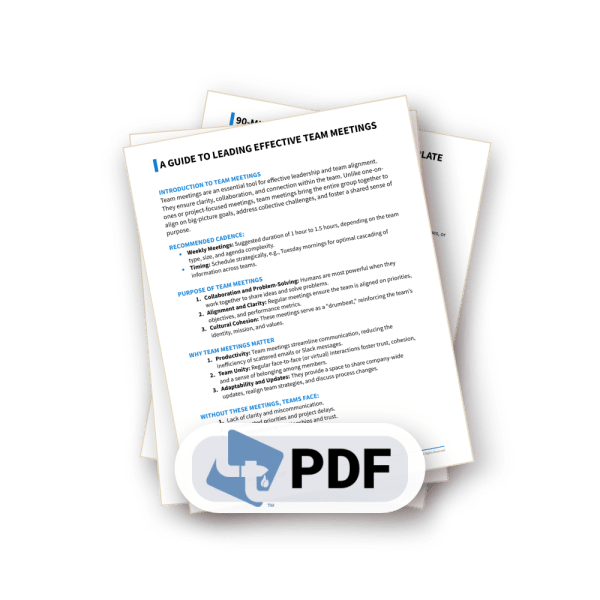
Leading Effective Team Meetings Starter Kit
A well-run team meeting can align priorities, strengthen collaboration, and drive action. This starter kit provides practical strategies, agenda templates, and facilitation techniques to help leaders make the most of their meetings.